
The UCP's attack on disabled Albertans...
A Breakdown Guest Op-Ed by Don Slater

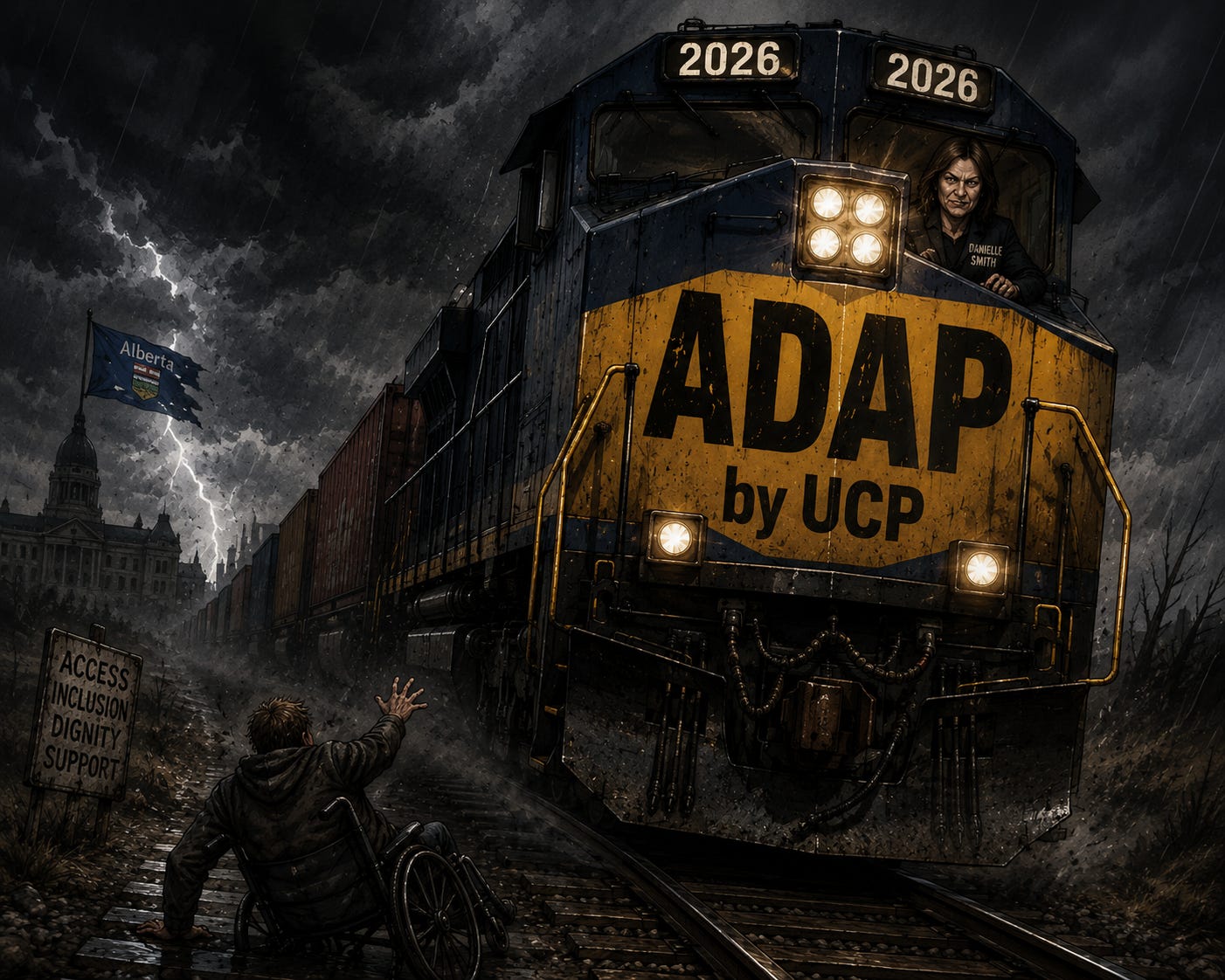
The UCP is increasingly revealing that the real political battle is not conservative versus liberal, but Up versus Down. The divide is no longer between ordinary Albertans with different opinions, but between concentrated power and the people expected to live beneath it.
We saw this clearly in the recent response directed at Calgary Mayor Jeromy Farkas, a fiscally conservative voice, who opposed the transition from AISH to ADAP. Farkas is not a socialist revolutionary. He is a conservative who believes in fiscal responsibility,
personal accountability, and community obligation. A glimpse into his character was seen during his 168-day journey along the Pacific Coast Trail in support of Big Brothers Big Sisters. That is not the behavior of a man who despises hard work or responsibility.
It is the behavior of someone who still believes society has obligations to one another.
Farkas and others asked the province to reconsider a transition that many disabled Albertans fear will treat them not as people living with permanent limitations, but as reluctant workers who simply need more pressure applied. The UCP appears to misunderstand what AISH was originally designed to be.
AISH was never meant to function as ordinary welfare. It was meant to recognize that disability itself imposes barriers and costs that cannot simply be overcome through willpower. Disability support is not merely charity. It is compensation for limitation,
loss of opportunity, and the unpredictable burdens that disability places upon a human life.
Farkas appears to understand something the current government does not, that many disabled people cannot participate in the workforce under the same conditions as healthy individuals. Some can work part time. Some can work intermittently. Some can work only from home, or only during periods when pain, fatigue, or mental strain are manageable. Others cannot work at all. A civilized disability system recognizes these realities.
AISH, at its best, was a foundation from which a person could rise if they could, not a stipend generated with Victorian poorhouse ideology.
The government’s response to criticism has often resembled political marketing more than serious engagement with these concerns. Suggesting that opponents of ADAP are trying to deny help to disabled people is like saying that a person who wishes to remove candy machines from high schools is trying to starve the children. It replaces discussion with slogans.
And while some people may accept arguments of such low logical quality, doing so reveals something troubling about modern politics. Too many citizens are being transformed into political team players rather than thinking individuals concerned with the well-being of their fellow man.
I often wonder when conservatism ceased meaning prudence, restraint, stewardship, and moral responsibility, and instead became synonymous with defending concentrated wealth at all costs.
When I was growing up, conservatism meant being careful with money while also understanding that a healthy society required strong communities, functioning institutions, and compassion toward the vulnerable.
Today, many ordinary people are encouraged to direct their frustration downward instead of upward. They are taught to resent immigrants, the poor, the disabled, or anyone receiving help, while paying little attention to the enormous concentration of wealth and influence occurring at the top of society.
No Albertan should wish to see the mega wealthy absorb ever more of the economic pie while ordinary people struggle harder to remain stable. The idea that the wealthiest individuals and corporations require constant political protection is absurd. They are already the most powerful actors in society. They have lobbyists, public relations firms, legal teams, and enormous influence over public discourse.
Meanwhile, the tradesman, the farmer, the nurse, the office worker, and the disabled citizen are increasingly told to compete against one another for scraps while the upper tiers accumulate more capital and more influence over the rules themselves.
As a former tradesman who paid high taxes and later became disabled through the actions of another person, I understand both work and disability. I understand the pride of contributing. I also understand how quickly life can change.
As a former Lougheed Conservative, I also remember a time when conservatism combined fiscal prudence with moral compassion. Peter Lougheed understood that stable societies are not built merely through markets, but through mutual obligation and human dignity.
To modern conservatives, I would simply ask this, return to your roots.
Fiscal responsibility is important. Waste should be opposed. Governments should be efficient and accountable. But do not allow yourselves to be convinced that compassion is weakness, or that your fellow citizens are your enemies simply because they require help.
The true division in society is not conservative versus liberal. It is between ordinary people struggling to maintain dignity, and systems of power that increasingly demand more from them while giving less in return.
When people are persuaded to believe that even the most vulnerable among us are somehow cheating them, they enter a world where loving thy neighbor is treated as foolishness, and where Dog Eat Dog replaces community itself.
That is not strength. It is the erosion of humanity.
Don Slater is a disability advocate who has been awarded the Queen Elizabeth II Platinum Jubilee Medal, the King Charles III Coronation Medal and the Sovereign’s Medal for Volunteers.
I think there will have to be an entirely new Party in order for things to return to what you remember. The current Conservatives are nothing like that and I don't believe they ever will be. That Party has morphed into something entirely different and no part of it is good.
Great essay. Up versus down.
It’s easy for the ucp to punch down on the most vulnerable and then in turn treat their friends and family to generous corporate welfare.
Gives them big wood